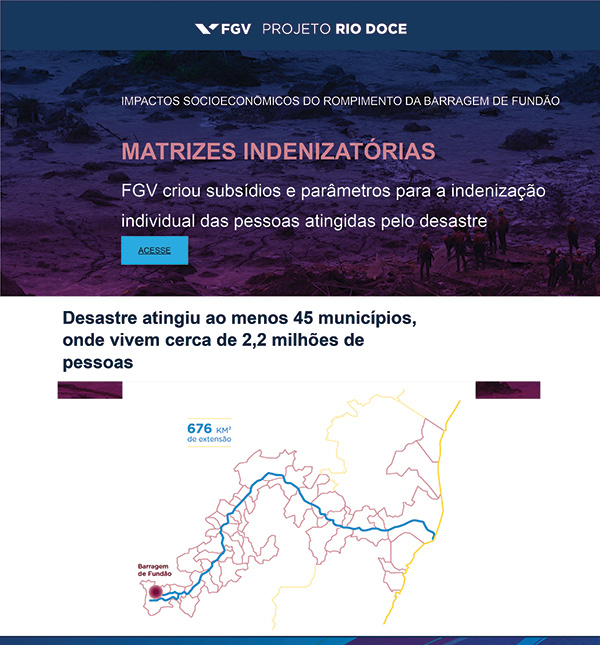
Fundação Getulio Vargas’ Doce River Project (Projeto Rio Doce), set out to identify and assess the social and economic damage caused by the failure of the Fundão tailings dam in Mariana, Minas Gerais, in November 2015, which affected at least 45 municipalities along the Doce River Basin. The project ran for 54 months, from June 2018 to November 2022.
FGV’s participation was established through an agreement signed in 2017 by the Federal Public Prosecutors’ Office, the Minas Gerais State Public Prosecutors’ Office, mining company Samarco Mineração S.A., which operated the dam, and Samarco’s joint owners, Vale S.A. and BHP Billiton Brasil Ltda. This agreement provided for technical and scientific support to be supplied to the Federal Public Prosecutors’ Office in the process of ensuring comprehensive reparations for the damage caused by the disaster.
Considering the complexity of the project, which involved five different coordination and technical teams across various areas of expertise and a staff of up to 160 employees, a dedicated project management office was set up to assist with the project’s management and monitoring. This work was coordinated by the project’s general manager, Professor Leandro Alves Patah.
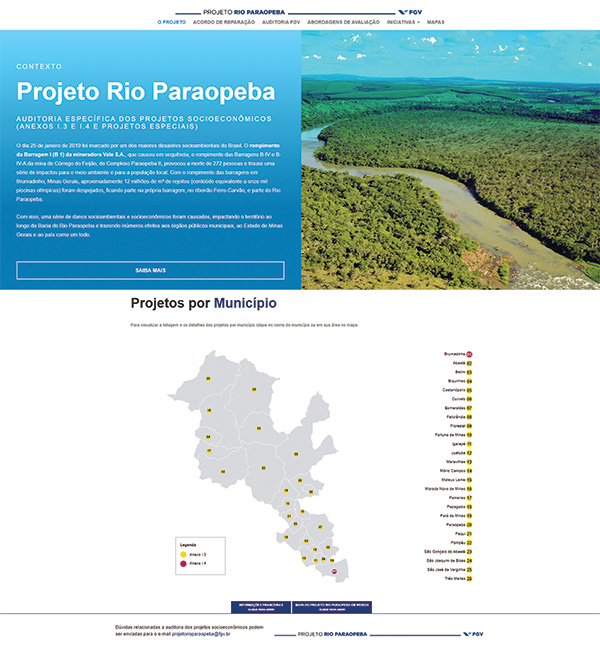
In 2021, given its experience with the Doce River Project, FGV was commissioned to audit the socioeconomic projects carried out in response to another tailings dam failure in Minas Gerais, in the municipality of Brumadinho. These projects were provided for in appendices I.3 and I.4 and the Special Projects section of the Judicial Agreement for Comprehensive Reparation in Brumadinho. This work by FGV became known as the Paraopeba River Project (Projeto Rio Paraopeba).
The judicial agreement was signed by the state government of Minas Gerais, the State Public Prosecutors’ Office, the State Public Defender’s Office, the Federal Public Prosecutors’ Office and mining company Vale S.A. The objective was to compensate for part of the damage caused by the collapse of Vale’s B-1 dam, which triggered the failure of the B-IV and B-IV-A dams, all at the Córrego do Feijão iron ore mine, part of the Paraopeba II mining complex. This disaster killed 272 people and generated a series of impacts on the environment and the local population.
The role of FGV’s Paraopeba River Project is to support the public authorities’ decisions by providing information on the quality of the physical and financial execution of the socioeconomic projects provided for in the Judicial Agreement for Comprehensive Reparation. The project began in October 2021 and is ongoing.
Drawing on the experience gained from managing and executing the Doce River and Paraopeba River projects – both highly complex in terms of their size, scope and stakeholders – FGV’s Center for Applied Research Quality (CQPA) established the FGV Project Management Office (FGV PMO) on September 28, 2022, with the goal of expanding FGV’s capacity to manage such projects. Professor Leandro Alves Patah was appointed to lead the area, which began reporting directly to FGV’s president in February 2024.
Currently, FGV PMO continues to provide strategic project management services, seeking to promote collaboration and optimize the use of resources in projects, expanding the capacity of Fundação Getulio Vargas’ schools, centers, administrative areas and other bodies to manage complex large-scale projects.
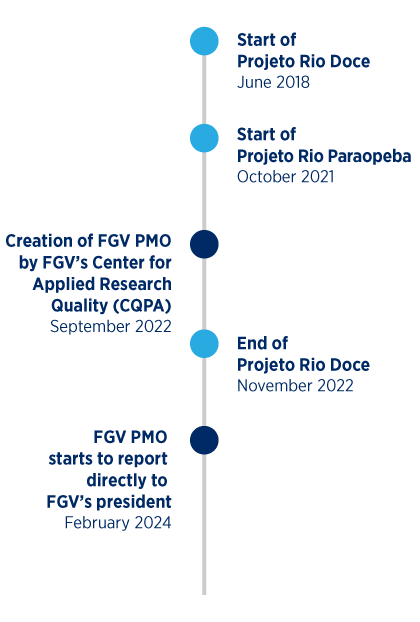
FGV PMO’s Timeline
- Start of Projeto Rio Doce – June 2018
- Start of Projeto Rio Paraopeba – October 2021
- Creation of FGV PMO by FGV’s Center for Applied Research Quality (CQPA) – September 2022
- End of Projeto Rio Doce – November 2022
- FGV PMO starts to report directly to FGV’s president – February 2024